Empowering Refugees Through Technology
Empowering Refugees Through Technology
Introduction
Empowering Refugees Through Technology in Kakuma refugee camp involves providing access to digital resources and tools to improve their livelihoods and quality of life. Kakuma Refugee Camp is a refugee settlement located in Turkana County, Kenya. It was established in 1992 in response to a significant influx of refugees fleeing conflict and persecution in neighboring countries, primarily Sudan (now South Sudan) and Ethiopia. Over the years, Kakuma has grown into one of the largest and most complex refugee camps in the world.
Intergration in between
The host community in the area is largely made up of Turkana residents who are pastoralists and lead semi-nomadic lifestyles. These residents live in small villages without access to basic amenities such as running water or electricity. As of December 30th, 2022, the Kakuma camp and the nearby Kalobeyei settlement have a combined population of 248,929 refugees.
Most of the refugees in the camp are from South Sudan, Sudan, Somalia, the Democratic Republic of Congo, Burundi, Ethiopia, and Uganda. These individuals fled their home countries due to ongoing conflicts that have lasted for decades.
What are the digital skills for refugees?
Digital skills training for refugees and other migrants cover a wide range of skills and areas of work, ranging from basic computer skills to micro work and advanced skills in web development, programming, and data science, as well as “soft skills”, language skills, and career coaching.
How does technology help refugees?
Digital access and connectivity is immensely important to refugees. Among other things, it can help them overcome feelings of isolation, find peer support and stay connected to family, as well as access learning opportunities from other ends of the globe.
How do you empower refugees?
Help Refugees Access Education. Refugees need to have access to education because it can give them the knowledge and skills they need to rebuild their lives and contribute to their communities. Education can also help refugees cope with the trauma and stress they have experienced and give them hope for the future.
UNHCR protects people forced to flee their homes as well as stateless persons. They deliver life-saving assistance in emergencies, safeguard fundamental human rights, and help find long-term solutions so they can find a safe place to call home
Role of Technology in Supporting Refugees’ Interaction with Governments
Empowering Refugees Through Technology in Communication with local government and/or public authorities is a critical first step of the asylum process. Upon arrival, refugees have to go through a series of procedures at various governmental institutions to start the asylum applications and other formalities, which include acquiring a residence permit, getting health insurance and securing accommodations, among others.
Since most refugees do not speak the local language, they face major difficulties in their face-to-face communication with government representatives. Moreover, most of the relevant websites do not offer information in languages other than the local ones. In fact, cultural adaptation of the governmental websites is almost non-existent, with the design of citizen-centric websites remaining an elusive problem (Tan et al., 2013). Confronted with this situation, refugees creatively resort to technology to connect with authorities (Díaz Andrade and Doolin, 2016). Examples include the use of online dictionaries, speech recognition translators and email communication, just to name a few (AbuJarour et al., 2016).
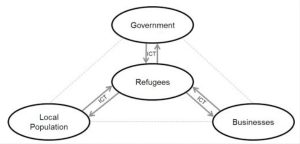
Conceivably, many of refugee needs in this area still have to be addressed. Against this backdrop, we propose to discuss the following issues during the panel: Best Practices and Challenges: What are the solutions that have been proven to be viable in enhancing the communication of refugees with the government? How can technology ease the collaboration of volunteers and governmental agencies? Can research on intercultural user experience help to improve e-government solutions for refugees (e.g., to eliminate bureaucratic red-tape)? What are the challenges encountered by governments in offering e-services (e.g., privacy issues and surveillance)? How prepared are governmental agencies in accommodating refugees’ ICT-mediated communication practices? Which processes are best suited for automation? Where are the limits of technology when it comes to refugee-government interactions? How can technology be leveraged to consolidate information and knowledge from numerous governmental agencies for refugees?
How are ICTs implicated in the interaction between governmental agencies and refugees How can refugees harness ICTs to become active participants of the public sphere in their host country?
Role of Technology in Supporting Refugees’ Interaction with the Local Population
Empowering Refugees Through Technology ans Finding common ground and building new friendships in a culturally distinct society is a daunting process. Here, ICTs can help refugees and locals to get to know each other in a specific context, thereby culminating in greater social inclusion. For example, the ‘www.start-with-a-friend.de’ initiative facilitates personal encounters between refugees and locals, viewing it as the first step to socially integrate refugees by exposing them to employment opportunities and the local language.
Against this backdrop, we propose to discuss the following issues during the panel: Best Practices and Challenges: What are the opportunities and challenges of leveraging technology to support communication between refugees and the local population? Which existing initiative(s) seems to work better in connecting refugees and locals and why? What are the distinguishing features of these initiates? How can ICTs facilitate better understanding of the host society, its traditions and social practices?
What impact can technology have on the long-term integration of refugees (e.g., provision of interactive platforms to bridge refugee communities with the local population)